

When it comes to applying for an Australian Partner visa, one of the biggest decisions couples face is whether to use migration agents vs DIY (do it yourself). Both options have their pros and cons and understanding them can save you time, stress, and money.
In this guide, we’ll compare migration agents vs DIY Partner visa applications, looking at the real differences in cost, complexity, and risk. You’ll learn when a do-it-yourself approach can work, when professional help is worth the investment, and practical steps to make sure your application is strong and well-prepared either way.
Key Takeaways:
- Partner visas are more complex than most expect. Missing or poorly presented evidence can cause refusals.
- DIY can work for straightforward cases with motivated applicants who follow instructions and gather strong, organised evidence.
- Migration agents add value through strategy, presentation, and deep knowledge beyond just filling forms.
- We often fix DIY applications that failed for small, avoidable mistakes.
- Certain situations such as complex past relationships, prior refusals, health, or character concerns strongly benefit from professional help.
- The financial risk of refusal usually outweighs agent fees, especially when delays or appeals follow a rejection.
- If budget is tight, consider limited advice, document reviews, or starting DIY then hiring help if things get hard.

Deciding between a DIY Partner Visa application and working with a migration agent can feel overwhelming. With more than 45 years of immigration experience, Carlos Sellanes and the team at Sellanes Clark Immigration Law Specialists can help you understand the safest, most effective path for your situation. Visit our website to learn how expert guidance can protect your application from avoidable risks.
Understanding Partner Visa Applications
Types of Partner Visas
You may know there are two main pathways for an Australian Partner Visa – onshore and offshore. Each pathway has a temporary-and-permanent sequence for most applicants. For example, if you apply onshore you usually get a temporary visa first (subclass 820) and then a permanent visa (subclass 801) later. Offshore applicants normally follow the 309 (temporary) then 100 (permanent) path. Processing times vary but commonly range from about 12 to 24 months for both stages together, depending on evidence and complexity.
- Onshore stream: apply while you are in Australia; temporary then permanent stages.
- Offshore stream: apply from outside Australia; similar two-stage process.
- Married applicants: evidence of a genuine marriage is usually straightforward to present.
- De facto applicants: you normally need 12 months of cohabitation unless you have a registered relationship.
- After you assess which stream fits your situation, you can decide whether DIY is realistic or if you need professional help.
| Visa pathway | Onshore (820/801) vs Offshore (309/100) |
| When to apply | Onshore while in Australia; offshore from overseas |
| Relationship proof | Marriage certificate, joint bills, photos, affidavits, 12 months cohabitation for de facto |
| Work and travel rights | Onshore temporary visa usually gives work and travel rights; offshore depends on visa |
| Typical processing | Often 12–24 months combined; complex cases take longer |
Common Requirements for Applications
You must show that your relationship is genuine and ongoing. That means clear, organised evidence including a marriage certificate if married, shared bills, joint bank statements, photos over time, and statements from friends or family. You should also prepare proof of financial interdependence, like joint leases or shared mortgage documents. I often see DIY bundles fail because evidence is scattered or lacks dates and context.
Health and character checks are mandatory for most applicants. You will need police certificates from each country where you lived for 12 months or more in the past ten years. Medical exams must be done by a Department-approved panel doctor. Also, provide identity documents like passports and certified translations for any non-English records.
More practically, organise a single clear timeline of your relationship and label each piece of evidence. If you present a date-ordered file with short notes on why each document matters, decision makers assess your case faster and more positively.
DIY Applications: A Step-by-Step Guide
DIY Step Checklist
| Step | What to do / example |
| Assess eligibility | Confirm you meet the partner criteria. For de facto partners, show 12 months of living together unless exempt. |
| Gather identity documents | Passports, birth certificates and certified translations if not in English. |
| Collect relationship evidence | Joint leases, 12 months of shared bills, joint bank statements, photos and travel itineraries. |
| Get statements | Provide 3–6 statutory declarations from friends or family who know your relationship. |
| Health & character checks | Arrange police checks and medical exams when requested. Keep receipts and reference numbers. |
| Complete forms | Use ImmiAccount. Fill partner and sponsor forms, sign where required, and save copies. |
| Certify & translate | Have copies certified by a JP or solicitor. Use a NAATI translator or approved translator for documents. |
| Submit & track | Upload documents, pay fees, record the application ID, and monitor ImmiAccount for requests. |
Preparation and Gathering Evidence
You should start by making a clear evidence plan. List the five evidence types the department wants: identity, relationship, household, financial, and social. For a de facto partner visa you normally need proof of 12 months living together. That means leases, utility bills, joint mail, and dated photos covering at least one year.
Collect at least three statutory declarations from people who know you both. Provide concrete examples. For instance, include three joint bank statements showing shared expenses, a joint tenancy for 12 months, and travel bookings for trips you took together. I once rescued a DIY file missing certified translations. That cost the couple weeks in extra requests and avoidable stress.
Submitting Your Application
Use ImmiAccount to lodge online. Complete the partner form and the sponsor form, sign them, and upload all certified documents as PDFs. Pay attention to required formats and file sizes. Many refusals come from poorly labelled or missing files.
Create an evidence index or cover letter that lists every attachment. Number documents and reference them in the forms. For example, label bank statements “Evidence 12A–12F” and photos “Evidence 5A–5Z.” This makes it easier for an officer to follow your story.
After submission, check ImmiAccount daily for requests for more information. Respond quickly and fully. If you miss a request deadline, the department may decide without your additional evidence, which often harms the outcome.

Pros and Cons of DIY Applications
| Pros | Cons |
| Lower upfront cost — you avoid agent fees of $2,000–$5,000. | Higher refusal risk — a refusal can cost you thousands and months. |
| You control timing and how you present evidence. | You may miss key evidence or mislabel documents. |
| Good learning opportunity about the visa process. | The rules and assessment criteria are complex and change. |
| Works well for straightforward cases with clear joint records. | Complicated histories—prior visas, separations or overseas children—need strategy. |
| Flexible: you can pause and gather more documents. | Deadlines and time limits are easy to miss without tracking. |
| You can choose limited paid help, like a document review. | Limited help may not spot strategic framing or legal issues. |
| Privacy and control over your personal story. | Stress and emotional load fall on you and your partner. |
| Good for budget-conscious applicants with simple profiles. | Cost of fixing a refused application often exceeds agent fees. |
Benefits of Going Solo
You save money up front. Many migration agents charge between $2,000 and $5,000 for a partner visa. If your relationship history is simple and you have clear joint bank accounts, leases and photos, doing it yourself often works.
You also stay in full control of your story and timing. I’ve seen many applicants who prepared neat, chronological evidence and secured a grant without professional help. If you are organised, follow checklists and double-check every document, DIY can be efficient.
Risks and Challenges
You risk missing small but important rules. For example, omitting a 12‑month period of shared finances or failing to explain a past marriage can trigger additional questions or a refusal. Small gaps often lead to complex requests for further evidence.
Errors in format, translations, or certifying documents slow the process. Visa officers expect clear, organised evidence. When files are messy, they ask for more. That adds months and stress to your case.
We regularly help couples who started DIY and then needed professional rescue. In one anonymous example, a couple missed two police checks and a period of overseas residence. Fixing that took six months and extra fees — more than the cost of initial professional help would have been.
Partner Visa rules are complex, and even small mistakes in a DIY application can lead to long delays or costly refusals. At Sellanes Clark Immigration Law Specialists, our team combines decades of inside immigration knowledge with a proven track record across thousands of family visa cases. To see how our expertise can strengthen your application, visit our website today.
Engaging a Migration Agent: What to Expect
You will start with an initial assessment where the agent reviews your relationship history, identity, health and character issues. That meeting usually takes 45–90 minutes and will flag any high-risk issues like previous refusals or complex travel histories. You should receive a written scope of work and fee estimate after this meeting. Good agents provide clear timelines, a list of documents you must supply, and who on their team will do the work.
After engagement, expect a document collection phase, draft statements, and a formal lodgement package. Turnaround from engagement to lodgement commonly ranges from four to twelve weeks, depending on your responsiveness. If issues appear late — for example missing police checks or unclear evidence of cohabitation — costs and time will increase. I have taken over DIY files that needed extra 6–12 months of evidence gathering and extra legal submissions to resolve problems, which raised total professional fees by roughly 30–50% in those cases.
Services Offered by Migration Agents
Agents typically offer a range of services from a simple file review to full case management. Common services include detailed eligibility assessments, preparing a tailored document checklist, drafting your personal statements, compiling relationship evidence, and writing legal submissions that link your facts to the decision criteria. Many agents also manage lodgement, track your file with the Department, and handle requests for more information.
Some firms provide limited-scope options if you are budget conscious. Examples are one-off advice sessions, document reviews, or a final submission check before you lodge. I often offer a standalone file audit that flags missing evidence and estimates the risk of refusal. That audit usually reduces the chance of common DIY mistakes like disorganised evidence or incomplete timelines.
How to Choose the Right Agent
Check that the person is registered with MARA and ask for their registration number. Ask how many Partner visas they have lodged in the last 12 months and for anonymised examples of similar cases. Look for clear fees and a written engagement letter that explains what happens if extra work is needed. Avoid any agent who guarantees outcomes or presses you to sign without a written scope.
Trust and communication matter. Pick an agent who explains decisions in plain language and who will let you review drafts. Also confirm who actually works on your file — a senior agent or a paralegal — and how often you will get updates. Good agents will give a realistic estimate of time and likely costs for foreseeable complications.
Ask specific, practical questions before you sign. For example: “How many partner visas like mine have you lodged in the last year?” and “What would trigger an extra fee and how much would it be?” Request sample timelines and a short outline of the written submission they would prepare. These details reveal experience and how they manage unexpected problems.
Key Factors to Consider
You need to weigh a few clear points before deciding. Think about your relationship history, how much documentary proof you have, whether either of you has visa or legal issues, and how quickly you need a decision. I see around 40% of DIY files I review missing obvious documents like joint bills, photos with dates, or clear statutory declarations.
- Relationship evidence: photos, messages, joint accounts, leases
- Length and type of relationship: married vs de facto, 12+ months cohabitation
- Previous immigration history: refusals, cancellations, bridging visas
- Health and character issues: medicals, police checks, past convictions
- Timing and work/visa deadlines
- Budget and willingness to pay for reviews or full help
Any mistake in evidence or timing can add months of delay or put the whole application at risk.
Complexity of Your Situation
If you have a simple story, DIY can work. Examples of simple cases are married applicants with joint bank accounts, the same address for two years, and no prior refusals. You can gather and organise evidence yourself in these cases. I have helped couples who did this successfully with a short document review before lodgement.
More complex situations usually need professional input. Think about prior visa refusals, long periods apart, children from previous relationships, or character issues. These factors change how you must present evidence and explain circumstances. In those cases, strategic framing and legal knowledge can make the difference between grant and refusal.
Budget Constraints and Options
You should balance what you can afford against the risk you face. Agents often offer services from a single consultation up to full case management. Limited services include an hourly strategy call, a document checklist, or a pre-lodgement review. Full service covers drafting submissions, collecting evidence, and managing correspondence.
Low-cost routes exist, such as using government checklists, community legal centres, or free webinars. They help with basics but may not catch subtle problems. A midway approach is common: start DIY, then pay for a professional review before you lodge.
For practical budgeting, expect staged options: an hour-long consultation might cost AUD 150–400, a document review AUD 300–800, and full preparation AUD 1,200–6,000 depending on complexity; you can ask for fixed quotes and staged payments to manage cash flow.
Tips for a Successful Partner Visa Application
Be methodical: present consistent facts across forms, statements and documents. Case officers look for a clear, verifiable story—dates, addresses and financial links that line up.
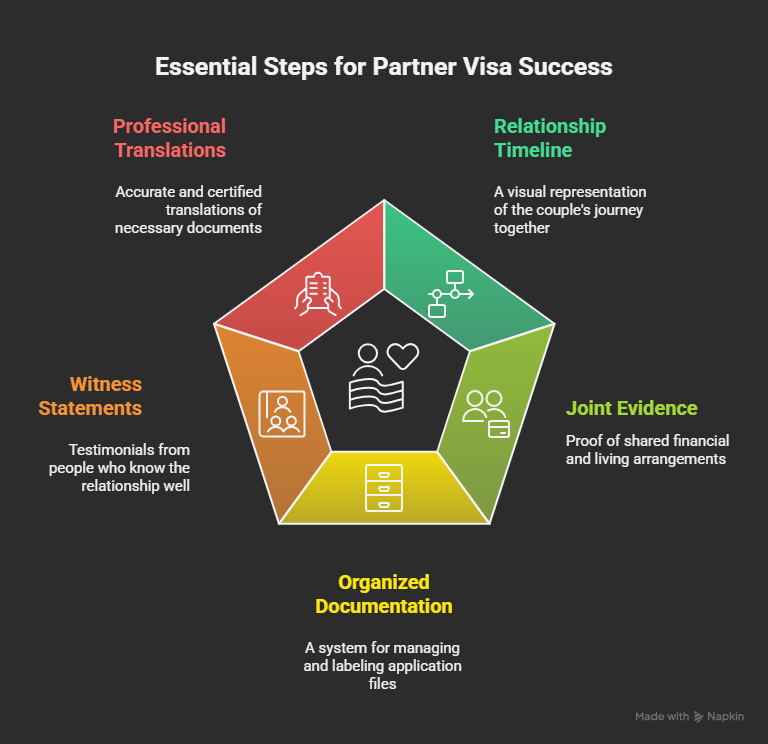
- Make a one-page timeline of your relationship with dates and linked evidence (rent, flights, messages).
- Provide at least 12 months of joint financial or living evidence where possible, or explain gaps with sworn statements.
- Use an evidence index and label every file clearly so a reviewer can find support quickly.
- Get witness statements from 3–5 people who genuinely know your relationship; ask them for specific examples.
- Translate documents professionally and include certified copies of any original certificates.
Perceiving small inconsistencies early gives you time to fix them before lodgement.
Organizing Your Evidence
Start with an index and a short cover letter that states what you are proving and why. Put critical items first: passports, marriage or registration certificates, and shared bills. I often see applications fail because reviewers must hunt for key documents.
Group evidence by theme: living together, finances, social life, and mutual commitment. Use clear file names and a numbered PDF binder. Include a one-page summary under each theme that points to the strongest three items, so a busy officer finds them first.
Common Pitfalls to Avoid
Inconsistent dates and missing supporting documents are the most common problems. For example, a couple claimed three years living together but provided only three months of joint bank records and no lease. That gap creates doubt and extra questions or refusals.
Vague witness statements and too many unlabelled photos add little value. Also, failing to explain previous visa refusals, criminal history, or long separations forces officers to guess. When you can, answer these issues clearly up front with evidence and short statements.
Perceiving gaps or weak points in your file early lets you get targeted fixes: add certified translations, obtain missing bank statements, draft clearer witness statements, or book a short review with an adviser to prioritise what to strengthen before lodgement.
Conclusion
Now you can weigh the trade-offs between applying yourself and hiring a migration agent for a Partner visa. You face paperwork, evidence, timelines and judgement calls that matter to your future. I have seen DIY applications succeed when couples are organised and honest. I have also seen them fail when evidence is missing or poorly presented.
If your relationship history is complex, you have health or character issues, or you’ve had a prior refusal, professional help often changes the outcome. If your case is straightforward and you are detail-oriented, DIY is a valid path. Consider a brief paid review if you want peace of mind and targeted advice without full representation. Use the checklist in this article and be honest with yourself about risk tolerance and capacity to manage the process.
Whether you choose the DIY route or want the confidence of professional support, understanding your options is essential. If you’d like personalised advice based on real experience, not guesswork, Carlos Sellanes and his team are here to help. Visit our website to discover how we guide Partner Visa applicants toward successful outcomes every day.
FAQ
Q: What is the main difference between using a migration agent and doing a DIY partner visa application?
A: The main difference is expertise and strategy. A migration agent brings experience, document strategy and relationship presentation. DIY relies on your research and organisation. Agents cannot guarantee outcomes but they reduce common application mistakes.
Q: When might a DIY application be a reasonable choice?
A: DIY can work for simple, well-documented relationships without legal complications. If you are organised, detail-oriented and confident following instructions, you may submit a successful application.
Q: What are common DIY mistakes applicants make?
A: Common mistakes include missing evidence, poor organisation, unclear timelines, inconsistent statements and failure to address health or character requirements. These gaps often lead to requests for more information or refusals, increasing cost and stress for applicants.
Q: What exactly does a migration agent do for a partner visa application?
A: Migration agents assess eligibility, develop document strategy, prepare statements and liaise with the Department. They spot risks early and advise on how to present your relationship. They also handle requests and appeals when required.
Q: Are migration agent fees worth the cost compared with DIY?
A: Agent fees add upfront cost, but a refusal can cost far more in time, money and stress. I’ve fixed DIY refusals where reapplications became more expensive than initial professional help would have been.
Q: In what situations should applicants definitely use a migration agent?
A: Hire an agent if you have complicated history, previous refusals, health or character issues, or complex evidence. In those situations I strongly recommend professional help to reduce risk and craft a persuasive, compliant application.
Q: Are there budget-friendly ways to use a migration agent without full representation?
A: If budget is tight consider limited services: document reviews, checklist help, or short consultations. I offer review sessions that catch common errors quickly, often saving time and lowering overall cost compared with full representation.
Author Bio
Carlos Sellanes is the founder and principal of Sellanes Clark Immigration Law Specialists, an Australian firm established in 2003. Carlos has more than 45 years immigration experience with over 20 years in practice and more than 25 years with Australia’s Department of Immigration where he gained unmatched insight into migration law and policy. Today, he leads a team recognised among the Top Ten Immigration Law Firms in the Asia-Pacific, offering expertise across skilled, family, and corporate visa categories. Through his blogs, Carlos shares practical updates and professional guidance to help clients navigate the complexities of Australian immigration with confidence. Learn more about Sellanes Clark Immigration Law Specialists.


