

Genuine De Facto Relationship for Partner Visa applications can feel tricky to explain, especially when you’re trying to show the everyday reality of your life together. Many couples worry about what “counts” as real evidence and how to present it in a way that makes sense to an assessor who has never met them.
This guide breaks everything down into simple steps. You’ll learn what proof matters most — from living arrangements and shared finances to social recognition and long-term commitment. I’ll walk you through practical examples, easy checklists, and insights I’ve gained from helping countless couples clearly tell their relationship story and meet the Partner visa requirements.
Key Takeaways:
- De facto relationships are fully recognised for Partner visas. You must show your relationship is genuine and ongoing.
- The main practical difference is proving 12 months of living together. Some exemptions exist for hardship, children, or extraordinary circumstances.
- Evidence must cover four areas: commitment, household, social life, and financial interdependence. Use multiple document types to tell the full story.
- Cohabitation proof is especially important for de facto couples. Provide leases, shared bills, mail, photos, and consistent address records.
- Statutory declarations from people who know you as a couple carry weight. You can use detailed witness statements to fill gaps and add context.
- A clear timeline and a heartfelt relationship statement help assessors understand how your relationship developed and why it is genuine.
- Professional guidance can identify weak spots and organise evidence so assessors can easily see the links across all four assessment areas.
Proving a genuine de facto relationship can feel overwhelming, especially with the high level of scrutiny applied to Partner Visa applications. With over 45 years of immigration experience, Carlos Sellanes and the team at Sellanes Clark Immigration Law Specialists can help you understand exactly what evidence matters most. Visit our website to learn how we can guide you through the process with clarity and confidence.

Understanding Genuine De Facto Relationships
What is a De Facto Relationship?
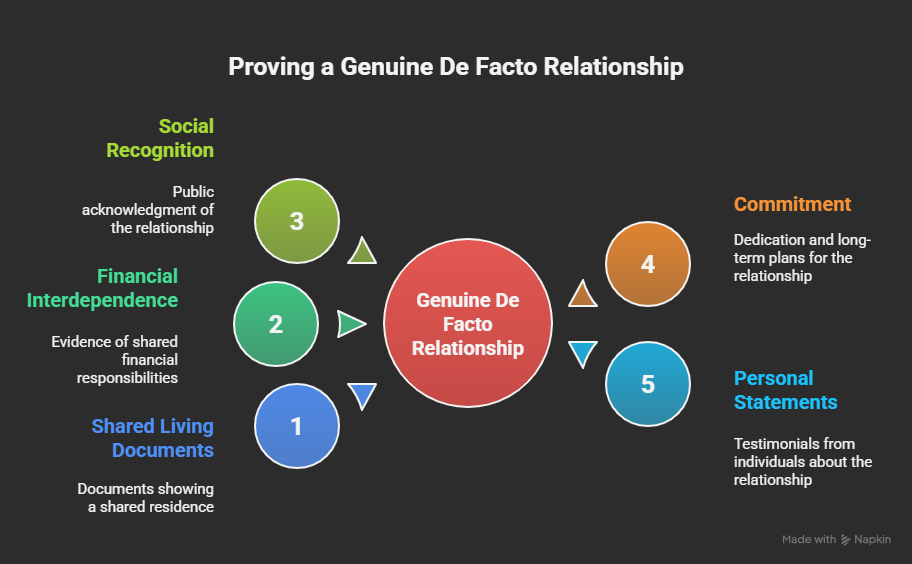
A de facto relationship is where two people live together as a couple but are not married. You usually need to show you lived together for 12 months unless an exception applies. Decision makers from the Department look at your relationship across four areas: financial ties, social recognition, the nature of your household, and your commitment to each other.
In practice, that means evidence like a joint lease, shared bank statements, utility bills at the same address, photos over time, and travel or appointment records. From my experience, clear timeline documents that show when you moved in and how your life developed make a big difference to assessors.
Recognition of De Facto Relationships
De facto relationships are treated the same as marriages for partner visas when you can show the relationship is genuine and continuing. You should present consistent evidence across the four assessment areas so assessors can see the full picture. I’ve managed successful cases where couples put together a clear package of documents and statements that matched their timeline and story.
Specific items that carry weight include a 12‑month joint lease or rental records, joint bank accounts and shared utility bills covering that period, and 4–6 statutory declarations from friends or family who know you as a couple. Photographs showing social life over months, itineraries for trips you took together, and shared medical or insurance records also help. If you have messages or emails that show ongoing planning and day‑to‑day life, include them as supporting material.
There are special situations to note. The Migration Act defines a de facto relationship as people living together on a genuine domestic basis, but exemptions to the 12‑month rule exist for things like having a dependent child together, registering your relationship in a state where that counts, or other compelling reasons that prevented cohabitation. If you’ve had long work separations or cultural reasons for delayed living together, document those facts clearly and provide supporting proof.
Key Factors for Proving Your Relationship
Evidence is judged across four areas: financial, social, household, and the nature of your commitment. You should show consistent, dated proof that your lives are intertwined. Good documents link to real events, not just isolated facts. For example, a joint lease spanning 12 months plus matching utility bills is strong. So is a bank statement showing regular transfers between partners over the same period.
- Financial: joint bank accounts, shared bills, joint loans, or beneficiary designations.
- Household: joint lease or mortgage, utility bills in both names, mail or packages delivered to one address.
- Social: invitations addressed to both of you, photos from trips, social media posts showing you as a couple.
- Nature of relationship: statutory declarations from friends or family, joint travel itineraries, evidence of living together and shared routines.
- Parenting and care: shared custody, school records, or joint medical records if you care for children together.
- Legal and safety documents: wills, powers of attorney, or insurance policies naming each other.
- Communication and timelines: dated messages, emails, and a clear relationship timeline tying documents to events.
- Assume that a single type of evidence rarely wins a case; you need a consistent package showing your life together.
The 12-Month Cohabitation Requirement
You normally must have lived together for 12 months before you apply. Evidence should cover the whole period. Lease agreements, joint utility bills, and continuous mail addressed to the same home are strong proof. Short trips or work-based absences are okay if you can show you intended to live together and resumed cohabitation.
Document temporary separations carefully. Provide dated travel tickets, employer letters, or rental records that explain why you were apart. We’ve seen cases where two months working overseas did not break the 12 months, because the couple showed return flights and correspondence proving intent to live together. A clear timeline linking those documents helps assessors see continuity.
Additional Criteria for Evidence
Assessors look for depth and consistency. For finances, show regular shared expenses or transfers, not just one-off payments. For household proof, provide multiple months of bills or a lease covering the period. For social proof, include dated photos from different settings and invitations or messages that place you together at events. For commitment, statutory declarations from several people who know your relationship add weight—make them specific and factual.
Quality beats quantity. A short, dated bank history showing ongoing shared spending is better than a box of undated screenshots. Create a one-page timeline that lists key relationship milestones and references each supporting document by number. That makes it easy for assessors to follow your story and match documents to dates.
I recommend you prepare evidence that tells the same story across all four areas. Cross-check dates and names so nothing contradicts another document. Provide translations for foreign documents and highlight pages that matter. This organised approach often moves an application from uncertain to clearly genuine.
Types of Evidence to Gather
| Shared living documents | Tenancy or mortgage papers, utility bills, letters from government showing the same address. |
| Financial interdependence | Joint bank accounts, shared loans, transfers for rent or bills, joint credit cards, shared asset purchases. |
| Social and public recognition | Photos with dates, joint invitations, social media showing you as a couple, membership records listing both names. |
| Commitment and household arrangements | Wills, superannuation nominations, joint insurance, shared bills, statements showing shared household roles. |
| Personal statements and witnesses | Relationship timeline, statutory declarations from friends and family, detailed personal statements from each partner. |
- Gather documents that span the whole 12‑month period if you can.
- Prioritise official documents with your shared address and dates.
- Collect bank statements that show regular transfers for household costs.
- Ask three to six people who know your relationship to write short declarations.
- Photographs with dates and captions help show the relationship over time.
Documentation of Shared Living Arrangements
Provide tenancy agreements or mortgage statements that cover the period you lived together. Include utility bills, council rates, or official mail that show both your names or at least the same address for each partner. If one partner moved in with the other partway through twelve months, show documents from both addresses and a clear timeline.
Photos of your home, dated and captioned, help show you lived together. Assessors look for consistency across documents. If you split time between households, include a detailed timeline and statutory declarations from people who can confirm how often you stayed together.
Evidence of Financial Interdependence
Supply joint bank statements, shared loan contracts, or regular transfers that show you split rent and bills. A pattern of monthly transfers—say $200–$500—can be persuasive if it repeats for many months. Also include receipts for large joint purchases like furniture or a car bought together.
Show invoices or bills in both names where possible. If you don’t have joint accounts, explain who paid what and provide supporting bank records. Include any documents that name one partner as beneficiary or next of kin, such as insurance or superannuation forms.
If your finances are separate, create a short spreadsheet showing who paid each major household cost and the dates. Add copies of the underlying transactions and at least two statements that match the spreadsheet. We use timelines like this in files I prepare for assessors because they make financial links clear and straightforward.
After you collect and label each item, organise everything chronologically and by category before you lodge your application.
If you’re unsure whether you have enough evidence, or the right kind of evidence, to satisfy the de facto requirements, you’re not alone. Many couples struggle to present their relationship convincingly. At Sellanes Clark Immigration Law Specialists, we help applicants structure their evidence into a strong, cohesive narrative. Visit our website today to see how our expertise can strengthen your Partner Visa case.
Practical Tips for Collecting Evidence
Collect evidence steadily, not at the last minute. Start as soon as you decide to apply and keep copies of everything. Use both paper and digital backups so nothing is lost. Aim to gather at least 12 months of cohabitation records, plus supporting items for finances, social life, and commitment.
- Make a simple timeline of key dates: when you met, moved in together, trips, major events.
- Keep 12+ months of rent or mortgage records and monthly utility bills in your name or joint names.
- Save joint bank statements or evidence of shared expenses and any joint assets or insurances.
- Collect photos with dates and short captions showing you as a couple across time.
- Ask 4–8 people to prepare statutory declarations with specific observations and dates.
- Scan documents into clearly named folders and keep an index or table of contents.
The consistent, organised presentation makes assessors’ work easier and strengthens your case.
How to Organize Your Documentation
Label everything and keep a master index. Create folders for the four assessment areas: financial, commitment, social, and household. Put documents in date order and give each item a reference number like F1, S2, H3 so you can point to them in your relationship statement. Short captions help; for example, “Photo P4: Bali trip, 12 March 2021.”
Use a single PDF for each folder and a final combined PDF for your main submission if possible. Back up files on cloud storage and a USB drive. If documents are in another language, include certified translations. I often tell clients to prepare a one-page table that lists each document, its date, and why it supports your story.
Importance of Statutory Declarations
You want statutory declarations that add independent, specific detail. Choose declarants who have known you both for at least six months and can describe real events. Family, friends, neighbours, landlords and employers all help when they provide different perspectives. Eight well‑written declarations can be more persuasive than twenty short, vague ones.
Each declaration should state the declarant’s name, contact details, how they know you, and concrete examples with dates. For example: “I stayed at their home on 10 May 2020 and saw shared mail addressed to both of them.” They must be signed and witnessed by an authorised person such as a Justice of the Peace or a notary, depending on where the declarant lives.
Make sure declarants avoid legal terms and stick to facts they saw or experienced. Help them include timelines and attach photos or messages if they have them, and check whether overseas declarations need notarisation or apostilles before you submit them.
Step-by-Step Guide to Submitting Your Application
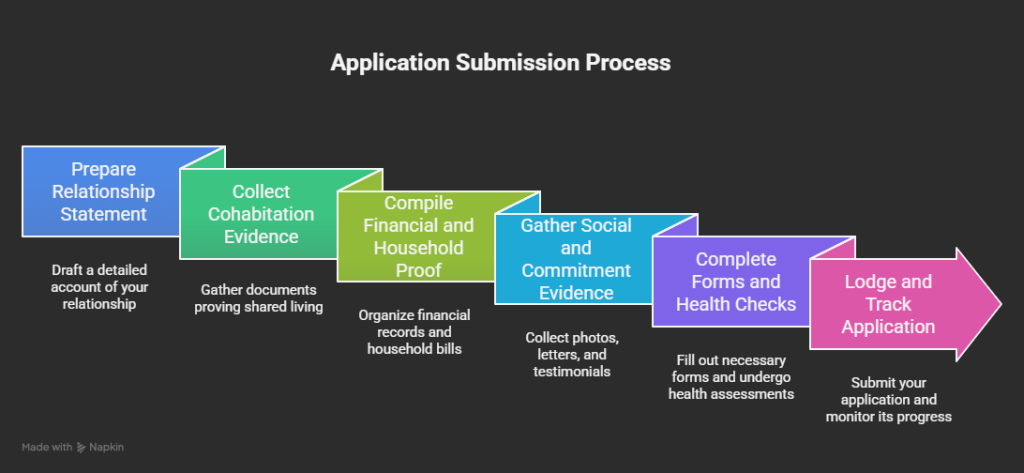
Step-by-step checklist
| Step | What to do and tips |
| 1. Confirm eligibility | Check you meet the 12-month cohabitation rule or an exemption. Note key dates and any time apart with reasons, for example work overseas or family care. |
| 2. Gather ID and basics | Passports, birth certificates, and police checks for countries you lived in more than 12 months. Scan originals and save high-quality PDFs. |
| 3. Prepare your relationship statement | Write a clear timeline of your relationship. Include dates, addresses, shared decisions and important events. Aim for 2–4 pages. |
| 4. Collect cohabitation evidence | Lease agreements, joint utility bills, shared mail, photos with dates, and travel bookings. Try to cover the 12-month period with at least six separate items. |
| 5. Compile financial and household proof | Joint bank statements, joint bills, shared assets like a car or furniture receipts, and proof of joint expenses such as grocery or rent payments. |
| 6. Social and commitment evidence | Photos with friends and family, invitations, social media posts, and joint memberships. Collect 5–10 statutory declarations from people who know you as a couple. |
| 7. Complete forms and health checks | Lodge in ImmiAccount and attach requested health and police checks. Pay fees and keep your transaction receipts and reference numbers. |
| 8. Lodge and track | Upload organised PDFs, note the lodgement date, and set reminders for any follow-up requests. Keep copies of every file you send. |
Preparing Your Relationship Statement
Tell your story in a simple timeline. Start with when and where you met, move through key events, and finish with your plan for the future. I suggest writing 2 to 4 pages. Use plain language and short paragraphs so an assessor can read it easily.
Include dates, locations and specific examples. For instance, write that you moved into 123 High Street on 12 March 2021. Say who pays the rent and how you share chores. If you have children, pets or shared loans, describe them and add supporting documents.
Presenting Your Evidence Effectively
Label everything and make it easy to follow. Create a contents page that lists each document with a short note. For example: “Tab 3 — Joint lease (1 July 2020 to 30 June 2021)”. Assessors read many files. Clear labels help them find what matters fast.
Group evidence by the four assessment areas: cohabitation, financial, social, and commitment. Put cohabitation first for de facto cases. Use numbered tabs or bookmarked PDFs. Provide at least six cohabitation items: a lease, three utility bills, mail showing both names, dated photos, travel bookings, and a shared insurance policy.
Make your statutory declarations strong and specific. Ask 5–10 people who know your relationship well to sign them. Each declaration should say how the person knows you, how long they have known you both, and give concrete examples of your life together, like attending family events or staying overnight.
Pros and Cons of De Facto Relationships
Pros and Cons at a glance
| Pros | Cons |
| Full access to Partner visa pathways when you prove the relationship | You generally need to show 12 months of cohabitation for de facto claims |
| Same rights and visa outcomes as married couples once recognised | Assessors expect more documentary proof of everyday life together |
| Greater flexibility in how you live and manage finances | Shared finances can be messy to document if you keep accounts separate |
| Less formal process if you don’t want marriage paperwork | Decision makers will closely scrutinise social and household evidence |
| Statutory declarations from friends and family carry strong weight | You may need multiple declarations and clear, dated supporting documents |
| Exemptions exist for some short separations or special circumstances | If you’ve lived apart a lot, you must explain and prove the reasons |
| Many de facto applications succeed with good preparation | Poor presentation of evidence raises the risk of a refusal |
| You can tailor your relationship statement to tell your story | Cultural or informal arrangements sometimes need extra context |
| Timeline documents and photos help show relationship development | Gathering consistent dated evidence can be time consuming |
| Assessors look for overall genuineness, not a marriage certificate | You must be more thorough with cohabitation proof than married couples |
Benefits of Being in a De Facto Relationship
You keep the same immigration options as married couples once the relationship is recognised. I’ve seen de facto couples gain Partner visas by showing 12 months of shared life, joint leases, joint bills, and three or more independent statutory declarations from people who know them well.
You also get flexibility in how you live and manage money. For example, some couples keep separate bank accounts but show shared expenses with dated receipts, joint tenancy agreements, and travel records to prove everyday life together.
Challenges You Might Face
Proving a de facto relationship often means more paperwork than a marriage. Assessors focus on the 12-month cohabitation rule, your social life as a couple, financial interdependence, and how you present your household arrangements. If you’ve had periods apart, you’ll need clear, dated evidence explaining why.
The Migration Act defines a de facto relationship as a couple living together on a genuine domestic basis. So you must show the reality of day-to-day life, not just emotional commitment. Photos, joint mail, lease names, and utility bills all help to paint that picture.
If you’ve lived apart for work or study, collect proof like employer letters, rental agreements, travel tickets, and statutory declarations that explain the arrangement. I recommend at least three independent declarants plus a clear relationship timeline with dates and supporting documents to make the assessor’s job easier.
Final Words
Upon reflecting, you should focus on showing shared life and commitment for a Partner visa. Gather clear evidence across four areas: financial, social, household and nature of the relationship. Joint bills, photos, messages, travel records and statutory declarations all help. Tell your story simply and honestly. If you have gaps in cohabitation, explain them with supporting documents.
You can be thorough without being perfect. Create a clear timeline and organise documents so an assessor sees your relationship arc. I have helped many de facto couples present evidence that shows their genuine bond. Professional guidance can make your application clearer and stronger.
Your de facto evidence will shape the outcome of your Partner Visa, and getting it right the first time can save months of delay or even avoid refusal. With decades of inside immigration knowledge, Carlos Sellanes and his team are here to help you present the strongest case possible. Visit our website to discover how we support couples in securing their future in Australia.
FAQ
Q: What evidence shows a genuine de facto relationship?
A: I advise combining joint bills, shared lease or mortgage documents, bank accounts, photos over time, travel records, and sworn statements from friends or family who know you as a couple. A clear timeline linking these items helps assessors.
Q: How long must we live together?
A: Generally, you must have lived together for 12 months before applying. Exceptions exist for compelling reasons like work, illness, or children. We can assess your circumstances and advise on evidence to prove the continuity of the relationship.
Q: Are statutory declarations helpful?
A: Yes. Statutory declarations from people who have observed your relationship add weight. I recommend statements describing how they know you, dates, and specific events. Paired with documentary evidence, they strengthen your application.
Q: What if we lived apart?
A: Living apart doesn’t end a de facto relationship. Provide evidence of ongoing commitment: regular communication logs, travel receipts, shared financial support, joint parenting arrangements, and explanations for separation.
Q: How much weight do photos and social media carry?
A: Photos and social media posts help show companionship over time. Include dated photos, captions, event details, and consistent posting. Combine them with official documents so assessors see both personal and formal evidence.
Q: Do we need joint bank accounts?
A: Joint bank accounts are strong proof of financial interdependence but are not mandatory. Provide evidence of shared expenses, transfers, bills in both names, and informal financial arrangements.
Q: How should we write our relationship statement?
A: Write a clear, honest statement that tells your story in chronological order. I recommend including dates, key milestones, daily routines, how you support each other, and why your relationship is genuine. Keep language simple and specific.
Author Bio
Carlos Sellanes is the founder and principal of Sellanes Clark Immigration Law Specialists, an Australian firm established in 2003. Carlos has more than 45 years immigration experience with over 20 years in practice and more than 25 years with Australia’s Department of Immigration where he gained unmatched insight into migration law and policy. Today, he leads a team recognised among the Top Ten Immigration Law Firms in the Asia-Pacific, offering expertise across skilled, family, and corporate visa categories. Through his blogs, Carlos shares practical updates and professional guidance to help clients navigate the complexities of Australian immigration with confidence. Learn more about Sellanes Clark Immigration Law Specialists.


