

Many couples wonder whether they can work in Australia while waiting for their Partner visa, and the answer is often yes — but the rules can feel confusing at first. Most onshore applicants receive a bridging visa that allows them to work, yet the timing, conditions, and exceptions vary from case to case.
In this guide, I’ll break down how work rights actually work, what to expect with your bridging visa, and how your job, taxes, and travel plans might be affected. You’ll also learn what to do if your current visa doesn’t include work rights, and practical steps to stay fully compliant while you wait for your Partner visa to be processed.
Key Takeaways:
- Onshore Partner visa applicants usually receive Bridging Visa A with work rights automatically.
- Work rights continue for the whole processing period so long as the bridging visa stays valid.
- Offshore applicants are not granted a Bridging Visa when they apply for their Offshore Partner Visa.
- You can work full-time with the same employment entitlements as other workers.
- Maintain bridging visa validity and plan travel carefully; leaving may require a Bridging Visa B to return.
- Get a TFN, arrange super and Medicare if eligible, and show employers your bridging visa as proof.
- If you cannot work, plan finances, seek sponsor support, and get professional advice.
Understanding your work rights while waiting for a Partner Visa can be confusing, especially with different rules applying to each Bridging Visa. With more than 45 years of immigration experience, Carlos Sellanes and the team at Sellanes Clark Immigration Law Specialists can help you navigate these complexities with confidence. Visit our website to learn how we can guide you through your visa journey.
Understanding Your Rights To Work In Australia
Your work rights depend almost entirely on where you lodged your Partner visa. Apply onshore and you will almost always get a Bridging Visa A (BVA) that lets you work full-time while your application is processed. I’ve seen clients in Melbourne and Sydney start full-time jobs within days of lodgement because the BVA gives them the same work access as other temporary visa holders.
If you lodged offshore, you cannot lawfully work in Australia while you wait. People applying from overseas — for example from Manila or London — must wait until the Partner visa is granted before starting paid work in Australia. That clear split between onshore and offshore is the single most important factor for your employment options.
Onshore vs. Offshore Applications
When you apply onshore you normally receive Bridging Visa A automatically. It replaces your previous visa and usually carries full work rights with no hours limit. That means you can get a Tax File Number, be paid into super, and use your bridging visa grant letter to reassure employers that you are allowed to work.
Offshore applicants have a different reality. If your application was lodged while you were outside Australia, you won’t have a bridging visa that allows work here. If you are in Australia on a tourist or visitor visa and you apply offshore from outside, you must wait offshore for the visa to be granted unless you change your visa status to an onshore-applicable visa first.
Bridging Visa Basics
Bridging Visa A (BVA) is the common outcome for onshore Partner visa applicants. It keeps you lawful while the Department processes your application and, in most Partner cases, it includes work rights. Under the Migration Regulations, bridging visas can include work rights where the circumstances allow it, which is why your BVA grant letter is the key document employers will want to see.
Bridging visas usually stop being valid if you travel overseas without permission. If you need to leave Australia, you must apply for a Bridging Visa B (BVB) to return. Losing bridging visa validity means losing your work rights, so planning travel carefully is important.
Check your BVA grant letter for any special conditions and keep a copy to show employers. If the letter says you can work, you have the same workplace protections and entitlements as other workers. Get a TFN, open a bank account that accepts super contributions, and give your employer the bridging visa details so payroll can set you up correctly. If anything on the grant letter looks unclear, get advice early — it’s usually straightforward to fix but delays can affect pay and entitlements.
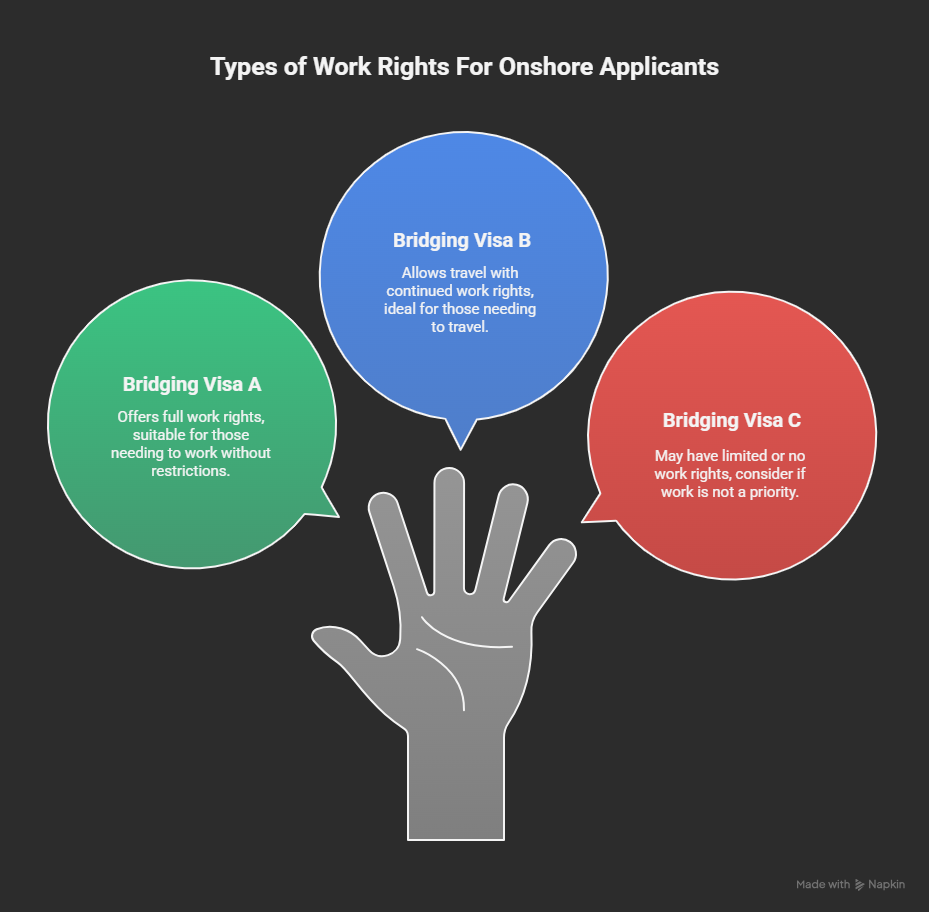
Types of Work Rights for Onshore Applicants
| Visa type | What it means for your work rights |
| Bridging Visa A (BVA) | Usually granted automatically when you apply onshore for a Partner visa and generally includes full work rights for partner applicants. |
| Bridging Visa B (BVB) | Allows you to leave and return to Australia. Work rights normally continue while the visa is valid. |
| Bridging Visa C (BVC) | Issued in some onshore cases when you had no substantive visa. Work rights may be limited or absent unless specified. |
| Substantive visa holders applying onshore | If you held a visa that allowed work before applying, you usually keep those work rights while waiting. |
Full Work Rights Explained
You can work full-time, part-time or casually if your onshore application gives you full work rights. Most partner applicants with a Bridging Visa A can accept any paid job, start a business, or take casual shifts without hour limits.
Practical example: a partner visa applicant I helped, moved from casual retail to a full-time role of 38 hours per week while waiting. Under the Migration Regulations, bridging visas can include work rights, so check your visa notice to see the exact wording.
- Get a Tax File Number (TFN) early so you can be paid correctly.
- Join superannuation if your employer provides it — you get the same entitlements as others.
- Tell employers you hold a bridging visa and show the visa grant letter if they ask.
- Keep your bridging visa valid by staying in Australia or applying for BVB before travel.
Conditions for Bridging Visa Holders
Bridging visas can carry different conditions. Some BVA holders get unrestricted work rights. Others may have a condition that stops work unless permission is granted. I often see confusion when the visa wording is short, so it helps to read the grant letter closely.
If you hold a BVB to travel, your work rights usually remain in force while that visa is valid. A BVC, given when you had no earlier visa, may not include work rights. Employers may ask for proof, so keep a copy of your visa and any written permission to work.
More detail: if your bridging visa does not clearly state you can work, you can apply to the Department for permission to work. Processing times vary, and you should avoid starting work until approval is confirmed to prevent compliance issues.
This is why checking your bridging visa conditions and getting clear proof of your work rights matters while you wait.
What Offshore Visa Applicants Need to Know
Restrictions on Work
If you apply for a Partner visa from outside Australia you cannot work in Australia while the application is being processed. You must remain outside Australia until the visa is granted. Under the Migration Regulations, bridging visas are generally only issued to applicants who lodge onshore, so you won’t get bridging visa work rights while offshore.
This means no paid employment, no gig work, and no casual jobs in Australia during the waiting period. Voluntary, unpaid community work is usually allowed, but check the specific rules where you are. I’ve seen couples who planned finances around this rule and needed short-term loans or partner support while waiting for the grant.
Options While Waiting
You have practical options even if you can’t work in Australia. One route is to apply for a different temporary visa that does allow work, such as a Working Holiday visa (subclass 417/462), a Temporary Skill Shortage visa (subclass 482) if an employer will sponsor you, or a Student visa which allows 40 hours of paid work per fortnight during study and more during breaks. Each visa has its own rules and eligibility tests.
If you remain offshore, you can work for employers in your home country or for overseas companies remotely. If you’re in Australia on another visa, always check the visa conditions before starting any work. From my Department experience, getting the correct temporary permission early prevents visa breaches and unnecessary complications later.
Practical steps you can take now include improving your savings buffer, discussing short-term financial plans with your partner, and exploring lawful remote work for overseas employers. If you plan to apply for a different temporary visa that permits work, prepare employer sponsorship paperwork or course enrolment documents in advance and seek advice so you don’t inadvertently break visa rules.
Work restrictions can significantly affect your plans, income, and stability while your Partner Visa is processing. At Sellanes Clark Immigration Law Specialists, we help applicants understand their options, remove uncertainty, and avoid common visa pitfalls. Visit our website today to see how our expertise can support your next steps.
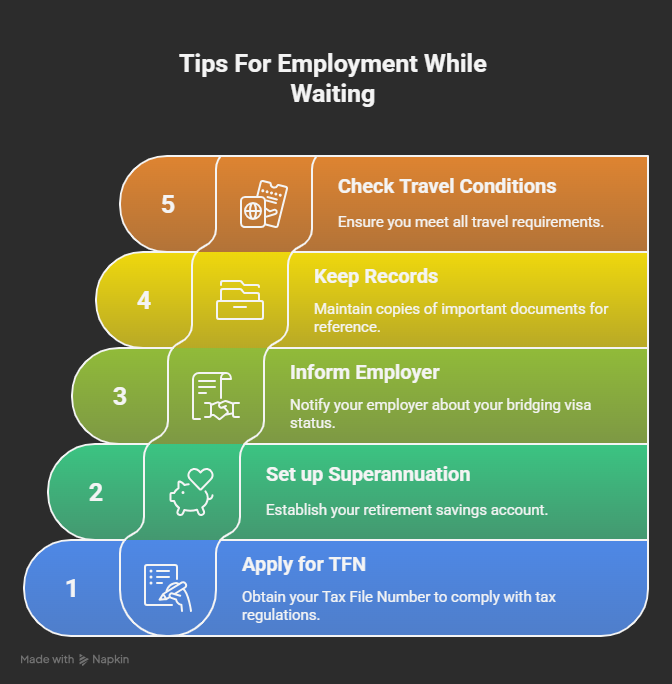
Practical Tips for Employment During the Wait
Keep your documents ready so you can prove your right to work at short notice. Employers will usually ask for a Tax File Number (TFN), evidence of your bridging visa and ID. Under the Migration Regulations, bridging visas can include work rights for onshore applicants, so carry your ImmiAccount screenshot or bridging visa letter when you start a job.
- Apply for your TFN as soon as you can — employers will ask for it on your first payday.
- Set up your superannuation account so contributions start from your first pay.
- Tell your employer you hold a bridging visa with work rights and show evidence.
- Keep copies of visa letters, pay slips and employer correspondence in one folder.
- If you plan to travel, check that leaving Australia won’t cancel your bridging visa work rights.
Recognizing the financial strain of waiting, I often advise clients to line up short-term work and build a small savings buffer.
Getting Your Tax File Number
You should apply for a TFN through the Australian Taxation Office (ATO) online portal. The TFN helps you avoid higher tax withholding and lets your employer set up payroll correctly. In my experience, applying early prevents payroll delays and slows fewer admin problems later.
Expect the TFN to arrive in the mail in about 28 days if your identity is verified quickly. If you don’t have a TFN, employers must withhold tax at a higher rate, which lowers your take-home pay. Keep a copy of the TFN confirmation in your records and give the number to your employer once it arrives.
Understanding Your Employment Rights
If you applied onshore, your Bridging Visa A normally gives you full work rights and lets you work full-time without special restrictions. You have the same minimum wage, leave entitlements and protections as other workers. I’ve seen clients keep full-time roles for years while their partner visas processed, and they were treated the same as any employee.
Offshore applicants cannot work in Australia while waiting for the partner visa. If you’re offshore, plan finances and consider short-term alternatives like remote work for overseas employers or savings. When employers ask for proof, show your bridging visa grant notice or ImmiAccount evidence so they can verify your status.
If an employer seems unsure or refuses to hire you because of your visa, politely provide documentation and suggest they check your bridging visa conditions online. You can also contact the Fair Work Ombudsman for guidance on workplace rights and unpaid entitlements if issues arise.
Recognizing that certainty about work rights eases stress, keep good records and get advice early if problems come up.
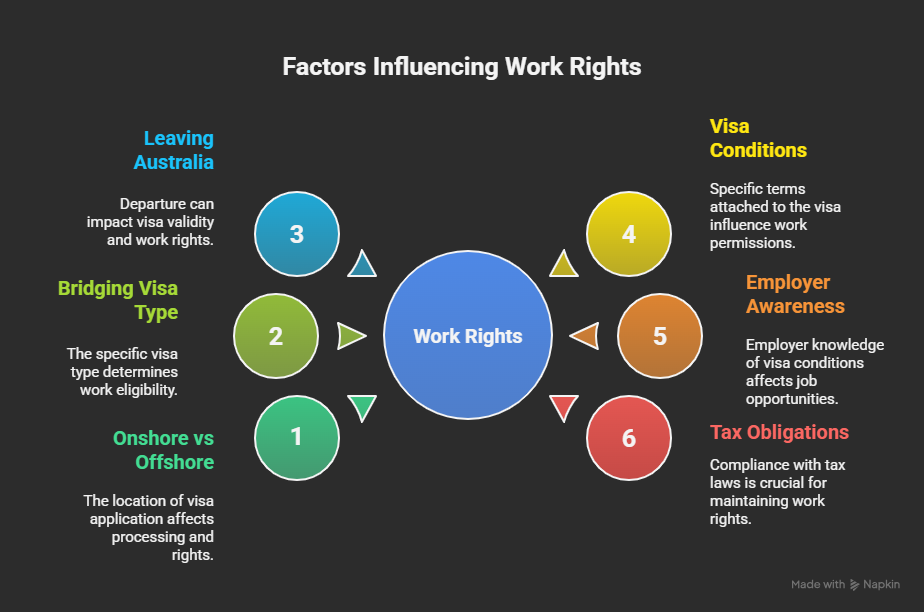
Factors Influencing Work Rights
Whether you can work while waiting for your Partner visa depends on a few key things. The main ones are where you applied from, which bridging visa you hold, and whether you leave Australia while your application is active.
- Onshore vs offshore application — onshore applicants usually get work rights.
- Type of bridging visa — BVA normally allows work; BVB lets you travel and keep rights.
- Leaving Australia — departing on a BVA usually cancels your work rights.
- Any specific visa condition attached to your bridging visa that says “No work”.
- Employer awareness — some employers ask to see evidence of your bridging visa.
- Tax and super obligations — you still need a TFN and to pay tax if you work.
This list shows the practical points you must check before accepting work.
Validity of Your Bridging Visa
If you applied onshore, you almost always get a Bridging Visa A (BVA) as soon as your partner application is lodged. From my experience, that visa will usually include full work rights so you can work full-time with no extra permissions. Under the Migration Regulations, bridging visas can include work rights, and a BVA is the common vehicle for that when you’re onshore.
Check your visa grant notice in your ImmiAccount or the letter from the Department to confirm the exact conditions. Your work rights can end if your substantive visa is cancelled or if you leave Australia without permission. If you plan to change your circumstances, contact us or the Department so you do not lose employment entitlements.
Impact of Traveling Overseas
If you leave Australia while holding a Bridging Visa A, that visa usually ceases as soon as you depart. In practice that means you will lose your work rights and cannot simply return to the same onshore status. Employers may not accept a visa that has been cancelled by travel.
To travel and keep your onshore work rights you need a Bridging Visa B (BVB) before you leave. A BVB preserves your lawful status while you are outside Australia and lets you return without losing work entitlements. Processing times vary, so apply well before planned travel dates.
Apply early for a BVB, tell your employer about planned travel, and get written permission from the Department if needed. If you work overseas for an Australian employer while on an invalid bridging visa, you may not be covered by Australian workplace protections or super rules.
Pros and Cons of Working While Waiting For Your Visa
Pros and Cons of Working While Waiting
| Pros | Cons |
| Immediate income to pay rent, bills and household costs | If you applied offshore, you cannot work in Australia while waiting |
| Work experience that keeps your CV current and skills sharp | Some employers may be unsure about bridging visa rights and hesitate to hire |
| Access to employer entitlements like super contributions and leave | You must keep your bridging visa valid to keep work rights — lapses cause problems |
| Faster financial independence reduces stress for you and your partner | Travel while on a bridging visa can affect your visa and work ability |
| Ability to get a Tax File Number and meet tax obligations early | Work can make it harder to attend appointments or gather documents for the visa |
| Practical proof of integration for future interviews or employer references | Certain visa conditions or later changes could limit hours or roles in rare cases |
| Helps build local networks and job leads for after the visa grants | Income can affect access to some social supports while you wait |
| Gives you bargaining power and confidence when negotiating work terms | Mistakes telling employers about your visa status can cause confusion |
Benefits of Employment
You can secure steady income that covers everyday needs. I often tell clients that steady pay reduces the pressure on relationships during the wait. Onshore applicants normally work full time with no hour limits, so you can keep up a normal job.
Working also gets you set up with a Tax File Number and employer super contributions. These are practical benefits that matter long term. For example, one client started full-time work and used that income to finish professional training within months.
Challenges and Considerations
If you applied offshore, you cannot work in Australia while waiting. That is the toughest limit many face. For onshore applicants, work rights depend on keeping your bridging visa valid and meeting any visa conditions.
Under the Migration Regulations, bridging visas can include work rights. You should tell employers about your bridging visa and show evidence if needed. Some employers still ask for reassurance, so having written proof of your bridging visa helps.
Think ahead about travel, tax and workplace rules. Travel overseas without the right travel facility can cancel your bridging visa and stop your work rights. Also, your employer must meet usual payroll, super and tax rules for you. If you lose work or change visa status, contact an immigration adviser quickly so you don’t fall into an avoidable gap.
Conclusion
Taking this into account, if you applied onshore you will usually have full work rights on your Bridging Visa A. You can work full time and have the same employment entitlements as other workers. If you applied offshore, you cannot work in Australia while the partner visa is processed.
Take steps now: get a TFN, set up super, and inform employers about your visa status. If you do not have work rights, plan savings, look for support and get legal advice early. I’ve worked with many couples and I can help you understand options and next steps.
Your ability to work in Australia during the Partner Visa wait can shape your financial and personal situation. Don’t rely on guesswork—get clarity from a team with decades of inside immigration knowledge. Visit our website to discover how Sellanes Clark Immigration Law Specialists can help you secure the strongest path forward.
FAQ
Q: Can I work in Australia while waiting for my partner visa?
A: Yes. If you applied onshore you generally get a Bridging Visa A with full work rights, letting you work while the partner visa is processed. I’ve seen this help applicants support themselves during long waits.
Q: Do I automatically get work rights when I apply onshore?
A: Yes. Bridging Visa A is usually granted automatically when you lodge an onshore partner visa. It includes permission to work. I’ve dealt with many cases where employers accept that visa as proof of lawful work entitlements.
Q: Can offshore applicants work in Australia while waiting?
A: No. If your partner visa application is offshore you do not have work rights in Australia while waiting. You must be outside Australia until the visa is granted.
Q: Are there limits on hours or type of work for onshore applicants?
A: No. Onshore applicants with bridging visas can work full-time with no standard hour limits. You have the same employment rights as other workers.
Q: What practical steps do I need to take to work legally?
A: You should get a Tax File Number and set up superannuation. Enrol in Medicare if eligible and show your bridging visa to employers as proof. We guide clients through these steps so payroll and entitlements are correct.
Q: Will travelling overseas affect my work rights?
A: Travel can affect your bridging visa and work rights. Leaving without the right travel authority may cancel your bridging visa. I always advise applying for a travel facility or planning travel carefully before you leave Australia.
Q: What can I do if I don’t have work rights while waiting?
A: If you lack work rights, seek alternatives: savings, sponsor support, study with a student visa allowing work, or temporary skilled work visas if eligible.
Author Bio
Carlos Sellanes is the founder and principal of Sellanes Clark Immigration Law Specialists, an Australian firm established in 2003. Carlos has more than 45 years immigration experience with over 20 years in practice and more than 25 years with Australia’s Department of Immigration where he gained unmatched insight into migration law and policy. Today, he leads a team recognised among the Top Ten Immigration Law Firms in the Asia-Pacific, offering expertise across skilled, family, and corporate visa categories. Through his blogs, Carlos shares practical updates and professional guidance to help clients navigate the complexities of Australian immigration with confidence. Learn more about Sellanes Clark Immigration Law Specialists.

